
By Inside Decors · Updated January 2026
Affiliate Disclosure: This article contains affiliate links. If you make a purchase through these links, we may earn a small commission at no additional cost to you.
Choosing the right rug can transform a room from disjointed to harmonious, but most homeowners struggle with one critical decision: size and shape. A rug that’s too small makes furniture look like it’s floating, while one that’s too large overwhelms the space and swallows your design elements. After working with hundreds of clients and testing rug placements in rooms ranging from 10×10 studios to 20×30 great rooms, I’ve learned that understanding rug dimensions isn’t just about measurements—it’s about creating visual balance, defining functional zones, and making your space feel intentionally designed.
This guide breaks down exactly how to select rug sizes and shapes for every room in your home, with specific measurements, placement rules, and real-world examples that go beyond generic advice.
Key Takeaways
- Standard rug sizes range from 3’×5′ accent rugs to 12’×15′ room-sized pieces, but the right size depends on your furniture arrangement, not just room dimensions
- The 18-inch rule: In living rooms, leave 18-24 inches of bare floor between the rug edge and walls for proper proportion
- All-on or front-on: Furniture should either sit entirely on the rug or have at least front legs on it—never place furniture completely off a rug in a seating area
- Shape matters: Round rugs soften angular spaces and work best under round tables; rectangular rugs suit most rooms; runners need 4-6 inches clearance on each side in hallways
- Dining room formula: Add 48 inches to your table dimensions (24 inches per side) to ensure chairs stay on the rug when pulled out
Understanding Standard Rug Sizes: What’s Actually Available

Before you can choose the right rug, you need to know what sizes manufacturers actually produce. While custom rugs exist, they’re expensive—typically 40-60% more than standard sizes. Here’s what you’ll find in most stores and online retailers.
Common Area Rug Sizes and Their Best Uses
Small Accent Rugs (3’×5′ and 4’×6′)
These work in tight spaces where you need a visual anchor without covering much floor. I use 3’×5′ rugs beside beds, in small entryways, or to define a reading nook. A 4’×6′ fits well in front of a bathroom vanity or under a small desk. Price range: $50-$300 depending on material.
Medium Rugs (5’×8′ and 6’×9′)
The 5’×8′ is the most versatile size I recommend for small living rooms (under 12’×12′) or under coffee tables in larger spaces. The 6’×9′ works in medium bedrooms (12’×14′) or small dining areas with tables seating 4-6 people. These typically cost $200-$800.
Large Rugs (8’×10′ and 9’×12′)
These are the workhorses of living room design. An 8’×10′ fits most standard living rooms (14’×16′), while a 9’×12′ suits larger spaces (16’×18′) or open-concept areas. In my experience, 8’×10′ is the minimum size for a proper living room rug where all furniture front legs sit on the rug. Expect to pay $400-$2,000.
Extra Large Rugs (10’×14′, 12’×15′, and larger)
Reserved for great rooms, open-concept spaces, or under large dining tables (seating 8-10+). A 10’×14′ works in rooms 18’×20′ or larger. These statement pieces range from $800-$4,000+.
Runner Rug Dimensions
Runners are typically 2′-3′ wide with lengths from 6′-14′. Standard sizes include:
– 2’6″×8′ (short hallways, kitchen galley)
– 2’6″×10′ (standard hallway)
– 2’6″×12′ (long hallways, stair runners)
– 3’×10′ or 3’×12′ (wider hallways, spacious kitchens)
The width should leave 4-6 inches of floor visible on each side in a hallway. For stairs, measure the tread depth plus riser height, multiply by the number of stairs, and add 12 inches.
Round Rug Sizes
Round rugs range from 3′ to 10′ in diameter:
– 3′-4′ diameter: Accent pieces, small breakfast nooks
– 5′-6′ diameter: Under small round dining tables (36″-48″), in entryways
– 7′-8′ diameter: Under larger round tables (54″-60″), in spacious seating areas
– 9′-10′ diameter: Statement pieces in large rooms, under king beds
Round rugs cost 10-20% more than rectangular rugs of comparable square footage because they generate more waste during manufacturing.
Rug Shapes: When to Use Each Style

Shape affects both aesthetics and function. Here’s when each works best, based on room geometry and furniture.
Rectangular Rugs: The Universal Choice
Rectangular rugs suit 80% of rooms because most spaces and furniture arrangements are rectangular. They work in:
– Living rooms with sectionals or sofa-plus-chairs arrangements
– Bedrooms (placed under the lower two-thirds of the bed)
– Dining rooms with rectangular or oval tables
– Home offices under desks
Pro tip: In narrow rooms (where length is 1.5× width or more), a rectangular rug emphasizes the length. If you want to visually widen the space, consider a square or round rug instead.
Square Rugs: For Symmetrical Spaces
Square rugs (5’×5′, 6’×6′, 8’×8′, 10’×10′) create visual balance in:
– Square rooms (12’×12′ bedrooms, 14’×14′ sitting rooms)
– Under square dining tables
– In the center of symmetrical furniture arrangements (four chairs facing each other)
I’ve found square rugs particularly effective in boho living room decor schemes where you want to emphasize a centered, grounded feeling.
Round Rugs: Softening Angular Spaces
Round rugs introduce curves into boxy rooms. They’re ideal for:
– Under round dining tables (rug diameter should be 24″ larger than table diameter)
– In rooms with lots of hard edges and rectangular furniture
– Small breakfast nooks or conversation areas
– Entryways with round console tables
Avoid round rugs in narrow hallways or tight rectangular spaces—they’ll look awkward and create tripping hazards at the edges.
Comparison: Rug Shapes at a Glance
| Shape | Best Room Types | Furniture Pairing | Visual Effect | Typical Cost vs. Rectangular |
|---|---|---|---|---|
| Rectangular | Living rooms, bedrooms, offices | Sofas, sectionals, beds, desks | Elongates space, traditional | Baseline |
| Square | Square rooms, symmetrical layouts | Square tables, four-chair arrangements | Balanced, grounded | +5-10% |
| Round | Dining areas, entryways, soft-style rooms | Round tables, curved furniture | Softens angles, casual | +10-20% |
| Runner | Hallways, kitchens, stairs | N/A (floor coverage) | Guides movement, protects floors | -20-30% per sq ft |
| Oval | Dining rooms, traditional spaces | Oval tables, classic furniture | Formal, traditional | +15-25% |
Room-by-Room Rug Sizing Guide

Generic size charts don’t account for furniture placement, which is what actually determines the right rug size. Here’s how to size rugs for each room based on real layouts.
Living Room Rug Sizes: The All-On vs. Front-On Debate
Small Living Rooms (10’×12′ to 12’×14′)
Use a 5’×8′ or 6’×9′ rug. Place it so the front legs of your sofa and chairs rest on the rug, with back legs off. This “front-on” approach works when you can’t fit all furniture on the rug. Leave 18-24 inches between the rug edge and walls.
Medium Living Rooms (14’×16′ to 16’×18′)
An 8’×10′ rug is the minimum for the “all-on” approach where all furniture legs sit on the rug. This creates a cohesive, anchored look. A 9’×12′ gives you more breathing room and works better if you have a sectional or multiple seating pieces.
Large Living Rooms (18’×20′ and up)
Use a 10’×14′ or 12’×15′ rug. In open-concept spaces, the rug defines your living zone separate from dining or kitchen areas. All furniture should sit entirely on the rug, with 12-18 inches of rug extending beyond the furniture on all sides.
Common mistake: Buying a rug that only fits under the coffee table. This makes your seating area look disconnected. The rug should unify all seating pieces, not just the table.
For more guidance on creating cohesive spaces, see our article on the 7 principles of interior design.
Bedroom Rug Sizes: The Two-Thirds Rule
In bedrooms, rugs typically go under the bed, extending out on three sides (both sides and the foot).
Twin/Full Beds
A 5’×8′ or 6’×9′ rug works. Place the rug so the top edge sits 12-18 inches under the bed from the headboard, with 18-24 inches extending beyond the sides and foot.
Queen Beds
Use an 8’×10′ rug. Position it so 18-24 inches extends on each side and 24-30 inches extends at the foot. This ensures you step onto rug, not cold floor, when getting out of bed.
King Beds
A 9’×12′ is standard, though a 10’×14′ works in master suites. The rug should extend 24-36 inches on each side and at the foot.
Alternative approach: Use two 3’×5′ or 4’×6′ runners on either side of the bed if you prefer more floor exposure or have a beautiful hardwood you want to showcase.
Dining Room Rug Sizes: The Pull-Out Test
The most common dining room mistake is buying a rug that’s too small. When you pull chairs out to sit, they slide off the rug and catch on the edge—annoying and damaging to both rug and floor.
The formula: Add 48 inches to your table dimensions (24 inches per side). This ensures chairs remain on the rug when pulled out 18-24 inches from the table.
Examples:
– 48″ round table → 8′ round rug (96″ diameter)
– 60″×36″ rectangular table → 9’×7′ rug (108″×84″)
– 72″×42″ table → 10’×8′ rug (120″×96″)
For tables seating 8-10 people (typically 84″-96″ long), use a 9’×12′ or 10’×14′ rug.
Shape matching: Use round rugs under round tables, rectangular under rectangular tables. An oval rug works under oval tables but rectangular is more common and less expensive.
Entryway and Hallway Rug Sizes
Entryways
A 3’×5′ or 4’×6′ rug works in standard entryways (5’×8′ or smaller). In larger foyers, use a 5’×8′ or 6’×9′. The rug should cover the high-traffic area where people step in and remove shoes, typically 3-4 feet from the door.
Hallways
Runners should be 6-12 inches narrower than the hallway width, leaving 3-6 inches of floor visible on each side. For a 42″ wide hallway, use a 30″ (2’6″) wide runner. Length depends on the hallway, but leave 6-12 inches of floor at each end.
Kitchen Rug Sizes
In kitchens, runners (2’6″×8′ to 3’×12′) work in galley layouts, placed in front of the sink and stove. For L-shaped or U-shaped kitchens, use a 4’×6′ or 5’×8′ rug in the central area. Choose low-pile, washable rugs—kitchen rugs take a beating.
Home Office Rug Sizes
For a desk and chair, use a 5’×8′ or 6’×9′ rug. The rug should extend at least 24 inches beyond the desk on all sides where the chair rolls. This prevents the chair from rolling off the rug onto hard floor, which damages both surfaces and makes rolling difficult.
How to Measure and Choose Your Rug Size: A Step-by-Step Process
Here’s the exact process I use with clients:
Step 1: Measure the room
Use a tape measure to get length and width. Note any architectural features (fireplace, built-ins, doorways) that affect furniture placement.
Step 2: Map your furniture arrangement
Measure your sofa, chairs, tables, and other key pieces. Sketch the room layout on graph paper (¼” = 1′ scale) or use a free tool like RoomSketcher.
Step 3: Apply the 18-inch rule
In living rooms and bedrooms, plan for 18-24 inches of bare floor between the rug edge and walls. This creates proper proportion. In small rooms (under 12’×12′), you can reduce this to 12-18 inches.
Step 4: Determine furniture placement
Decide whether you want “all-on” (all furniture legs on the rug) or “front-on” (front legs on, back legs off). All-on looks more cohesive but requires a larger, more expensive rug.
Step 5: Calculate rug dimensions
Based on your furniture layout and placement choice, calculate the minimum rug size. For example, if your sofa is 84″ wide and you want 12 inches of rug extending beyond each side, you need at least 108″ (9′) of width.
Step 6: Round up to standard sizes
Rugs come in standard sizes. If your calculation yields 7’×9′, round up to 8’×10′. It’s better to go slightly larger than smaller.
Step 7: Use painter’s tape to visualize
Before buying, use painter’s tape or newspaper to outline the rug dimensions on your floor. Live with it for a day or two. Does it look proportional? Does furniture placement work?
Step 8: Consider rug pad thickness
Add a rug pad (typically ¼” thick) for safety and longevity. The pad should be 1-2 inches smaller than the rug on all sides so it doesn’t show.
Common Rug Sizing Mistakes and How to Avoid Them
Mistake 1: Buying a rug that only fits under the coffee table
This is the #1 error I see. The rug should unify your seating area, not just anchor the table. Minimum size: front legs of all seating pieces should be on the rug.
Mistake 2: Choosing a dining rug that’s too small
If chairs slide off when pulled out, the rug is too small. Use the 48-inch rule (add 24″ per side to table dimensions).
Mistake 3: Ignoring room proportions
A tiny rug in a large room looks like a postage stamp. A huge rug in a small room overwhelms the space. Follow the 18-inch rule for proper proportion.
Mistake 4: Matching rug shape to room shape in narrow spaces
In a long, narrow room (10’×18′), a long rectangular rug emphasizes the narrowness. Consider a square or round rug to visually widen the space.
Mistake 5: Forgetting about rug pads
Rugs without pads slip, bunch up, and wear unevenly. Always use a quality rug pad—it extends rug life by 50% or more.
Mistake 6: Buying before measuring
Measure twice, buy once. I’ve seen clients purchase beautiful rugs that are 2 feet too small or too large because they eyeballed it.
Rug Materials and Pile Height: How They Affect Size Perception
The material and pile height influence how a rug looks and feels in your space, which can affect your size choice.
Low-pile rugs (¼” or less): Flatweave, kilim, and low-pile synthetic rugs make rooms feel larger because they don’t add visual weight. They work well in small spaces and under dining tables (chairs slide easily).
Medium-pile rugs (¼”-½”): Most wool and cotton rugs fall here. They add warmth without overwhelming the space. Good all-purpose choice for living rooms and bedrooms.
High-pile rugs (½”-1″+): Shag, Moroccan, and plush rugs add coziness but can make small rooms feel cramped. They work best in bedrooms and low-traffic areas. Avoid under dining tables—chair legs sink in.
Material considerations:
– Wool: Durable, naturally stain-resistant, expensive ($15-$50/sq ft). Best for high-traffic areas.
– Cotton: Affordable, washable, less durable ($3-$15/sq ft). Good for kitchens, kids’ rooms.
– Synthetic (polypropylene, nylon): Budget-friendly, stain-resistant, less luxurious feel ($2-$10/sq ft). Works for rentals, high-traffic areas.
– Natural fiber (jute, sisal): Textured, casual, scratchy underfoot ($5-$20/sq ft). Best for layering or low-traffic areas.
For recommendations on creating a cohesive look with various textures, check out our guide on top interior design styles and tips.
Budget-Friendly Rug Shopping: Where to Find Quality at Every Price Point
Under $200 (Small to medium rugs, 5’×8′ and under)
– Washable cotton rugs on Amazon work well for kitchens and kids’ rooms
– Rugs USA and Wayfair offer frequent sales on synthetic rugs
– HomeGoods and TJ Maxx have quality finds if you’re flexible on size/color
$200-$800 (Medium to large rugs, 6’×9′ to 8’×10′)
– Wool blend area rugs on Amazon offer durability at mid-range prices
– West Elm and CB2 sales (30-40% off) bring quality rugs into this range
– Overstock and Rugs Direct specialize in this price tier
$800+ (Large and extra-large rugs, 9’×12′ and up)
– Hand-tufted wool rugs on Amazon provide quality at better prices than boutiques
– Pottery Barn and Crate & Barrel for classic styles
– Rug Studio and Loloi for designer looks
– Etsy for vintage and one-of-a-kind pieces
Money-saving tips:
– Buy during major sales (Memorial Day, Labor Day, Black Friday—discounts reach 40-60%)
– Consider slightly smaller than ideal if budget is tight—a 6’×9′ instead of 8’×10′ still works if furniture placement is adjusted
– Layer a less expensive large rug with a smaller, higher-quality accent rug on top
– Check rug outlets and clearance sections for discontinued patterns
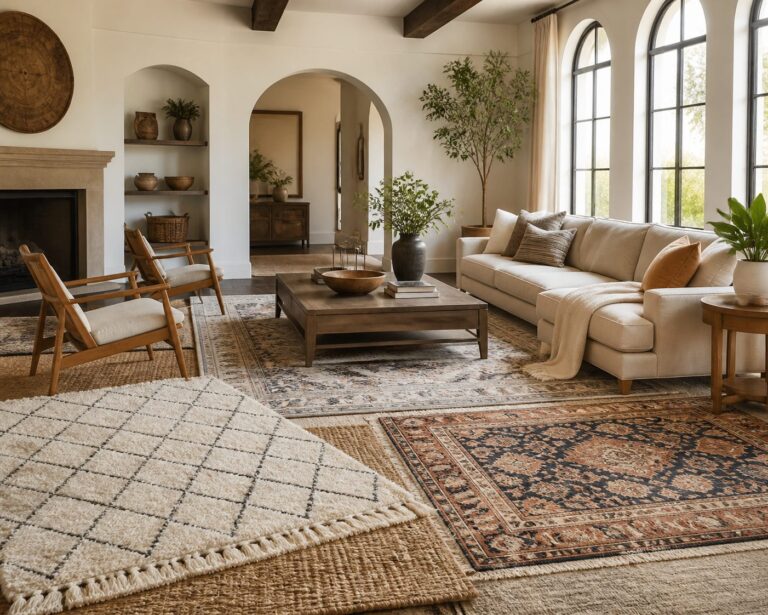
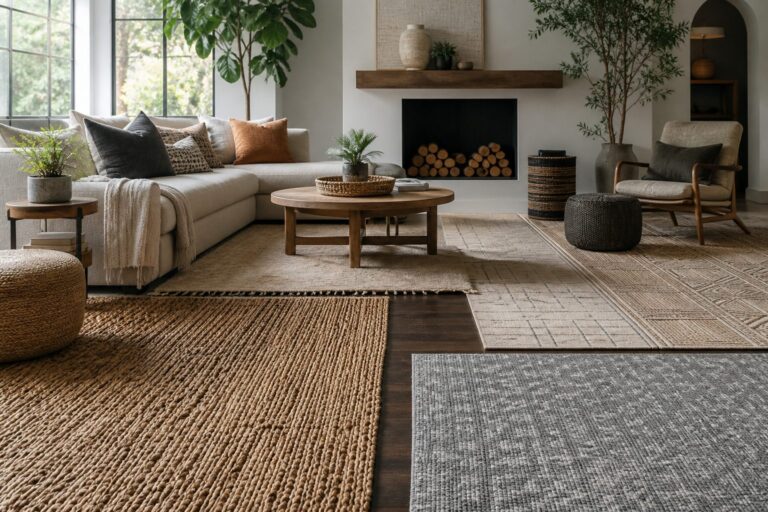
Rug Layering: When and How to Use Multiple Rugs
Layering rugs adds depth and allows you to use smaller, less expensive rugs to achieve the coverage of a larger one. This technique works particularly well in boho living room decor and eclectic styles.
How to layer successfully:
1. Start with a large, neutral base rug (jute, sisal, or low-pile solid color)
2. Add a smaller, patterned rug on top (typically 2-3 feet smaller on each dimension)
3. Ensure the top rug sits entirely on the base rug with 12-18 inches of base rug showing on all sides
Example: In a living room, use a 9’×12′ natural jute rug as the base with a 6’×9′ patterned wool rug on top, centered under the coffee table.
Where layering works best:
– Living rooms with neutral base rugs and colorful accent rugs
– Bedrooms with a large sisal rug and a plush smaller rug at the bedside
– Dining rooms with a durable flatweave base and a decorative top rug
Layering lets you achieve the coverage of an expensive large rug while spending 30-40% less.
Rug Placement in Open-Concept Spaces: Defining Zones
In open-concept homes, rugs define separate functional areas—living, dining, and kitchen zones. Here’s how to use rugs to create visual boundaries without walls.
Living zone: Use an 8’×10′ or larger rug to anchor the seating area. All furniture should sit on this rug. Leave 12-18 inches between the rug edge and the dining area rug.
Dining zone: Use a separate rug sized to your table (following the 48-inch rule). This rug should be distinct from the living rug but complementary in color or style.
Kitchen zone: If your kitchen opens to the living/dining area, use a runner or small rug in front of the sink. Keep this rug more utilitarian (washable, low-pile).
Color and pattern coordination: Rugs don’t need to match, but they should share a color palette or style. For example, use two different patterns that both include navy and cream, or use the same color in different shades.
For more on creating cohesive color schemes across zones, see our guide to the 60-30-10 decorating rule.
Seasonal Rug Swaps: Adjusting Size and Style Throughout the Year
Swapping rugs seasonally refreshes your space and allows you to adjust for comfort. This works best with smaller rugs (5’×8′ and under) that are easier to store and clean.
Summer: Use lighter colors, natural fibers (jute, cotton), and flatweave styles. These feel cooler underfoot and make spaces feel airy. Consider going one size smaller to expose more floor.
Winter: Switch to plush, high-pile rugs in warmer tones (burgundy, gold, deep blue). Go one size larger if possible to add warmth and coziness. Throw pillows in complementary colors complete the cozy look.
Storage tip: Clean rugs before storing (professional cleaning for wool, machine wash for cotton). Roll rugs (don’t fold) and store in a cool, dry place. Use cedar blocks to prevent moths.
Shop This Look
Editor-picked finds to bring this style home:
- Rectangular Area Rug →The most common rug shape, perfect for defining living or dining spaces.
- Round Jute Rug →Adds softness and a natural touch, ideal for entryways or under accent chairs.
- Runner Rug →Elongated shape, perfect for hallways, kitchens, or beside beds.
- Sheepskin Accent Rug →Small, plush, and adds texture; great for layering or cozy corners.
As an Amazon Associate we earn from qualifying purchases.
Frequently Asked Questions
What size rug should I get for a 12×12 living room?
For a 12’×12′ living room, use an 8’×10′ rug with the “all-on” furniture placement (all furniture legs on the rug) or a 6’×9′ rug with the “front-on” approach (front legs on, back legs off). The 8’×10′ creates a more cohesive look and leaves 12 inches of floor showing on each side, which is proportionally correct for this room size. If you have a sectional or multiple seating pieces, go with the 8’×10′ or even a 9’×12′ if budget allows.
How much bigger should a rug be than a dining table?
A dining room rug should be 48 inches larger than your table dimensions—that’s 24 inches extending beyond the table on each side. This ensures chairs remain on the rug when pulled out for seating. For example, a 60″×36″ table needs at least a 9’×7′ rug (108″×84″). If your table has leaves that extend it, measure the fully extended size and add 48 inches to those dimensions.
Can you put a round rug under a rectangular table?
While you can technically place a round rug under a rectangular table, it’s not ideal. The rug won’t extend evenly around the table—the corners will hang off while the sides may not have enough clearance for chairs. Stick with rectangular rugs under rectangular tables and round rugs under round tables for the best proportion and function. The exception is a small rectangular coffee table over a large round rug in a casual seating area, where the mismatch creates intentional visual interest.
What is the best rug size for a queen bed?
For a queen bed (60″×80″), use an 8’×10′ rug positioned so the top edge sits 12-18 inches under the bed from the headboard, with 18-24 inches extending on each side and 24-30 inches at the foot. This ensures you step onto rug, not floor, when getting out of bed. If budget is tight, a 6’×9′ works but provides less coverage on the sides. Alternatively, use two 3’×5′ runners on either side of the bed.
Should a rug go under a couch?
Yes, in most living room layouts, the rug should go under at least the front legs of the sofa. The “all-on” approach (all furniture legs on the rug) creates the most cohesive, anchored look and is preferred in formal or larger living rooms. The “front-on” approach (front legs on, back legs off) works in smaller rooms or when budget limits rug size. Never place a sofa completely off the rug in a seating area—this makes the furniture look disconnected and the room feel disjointed.
How do I choose between a round and rectangular rug?
Choose based on your room shape and furniture. Rectangular rugs work in most rooms and with most furniture arrangements—they’re the safe, versatile choice. Use round rugs when you want to soften a room with lots of angular furniture, under round dining tables, or in square rooms where you want to emphasize symmetry. Round rugs also work well in entryways with round console tables or in conversation areas with chairs arranged in a circle. Avoid round rugs in narrow or rectangular rooms—they’ll look awkward and create wasted space at the edges.
Transform Your Space with the Right Rug
Selecting the right rug size and shape isn’t about following rigid rules—it’s about understanding proportions, furniture relationships, and how rugs define space. A properly sized rug anchors your furniture, creates visual flow, and makes rooms feel intentionally designed rather than haphazardly furnished.
Start by measuring your room and furniture, then use the guidelines in this article to calculate the minimum rug size for your layout. Remember the 18-inch rule for wall clearance, the 48-inch rule for dining tables, and the all-on vs. front-on decision for living rooms. Use painter’s tape to visualize before you buy, and don’t be afraid to go one size larger than you think you need—undersized rugs are the most common mistake.
Whether you’re furnishing your first apartment or refreshing a longtime home, the right rug transforms a collection of furniture into a cohesive, comfortable space. For more ways to elevate your home’s design, explore our guide on making your home look expensive on a budget.
Ready to find your perfect rug? Start by measuring your space today, calculate your ideal size using the formulas above, and browse area rugs on Amazon to see what’s available in your size and budget range. Your room is waiting for the transformation only the right rug can provide.